





 Overview
Crossa, J., Montesinos-López, A., Cuevas, J., Montesinos-López, O. A., Pérez-Rodríguez, P., & Bentley, A. (2026). Multimodal genomic prediction is not a buzzword: why modern plant breeding must integrate genomics, enviromics, and phenomics. G3: Genes, Genomes, Genetics, jkag110.
https://doi.org/10.1093/g3journal/jkag110
Welcome back to Make Sense of Science, where we break down complex research into easier-to-understand insights. Today we are discussing a study comparing classical and ML learning-based phenotype prediction methods.
For many years, plant breeding has relied strongly on genomics. DNA markers help breeders predict which plants may perform best. This has made breeding faster, more targeted, and more data-driven. But today, the study argues, DNA alone is no longer enough. Crops now face stronger heat, irregular rainfall, and new disease pressure, resulting in even more changing growing conditions. A plant’s performance depends not only on its genes, but also on the environment and on how the plant responds to stress. This is why modern breeding needs multimodal prediction.
What is Multimodal Prediction?
Multimodal prediction means combining different types of data, such as:
Each data type tells part of the story. Genomics shows what a plant could do. Environmental data shows the conditions it must face. Phenomics shows how the plant actually responds. Only by combining these layers can models better understand why a plant performs well, where it performs well, and under which conditions it may fail.
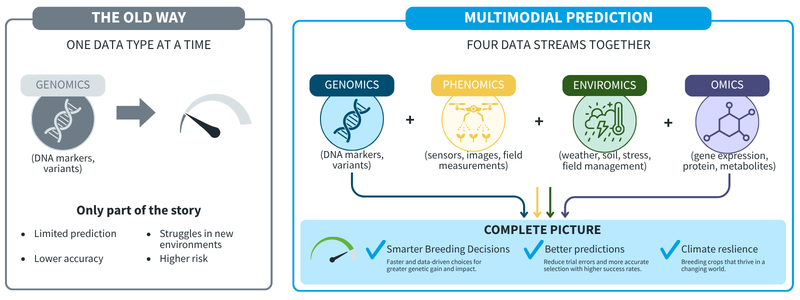
Fig. Plants are a living system. The best predictions come from integrating all the right data at the right time.
The Main Findings and Why This Matters
The study finds that multimodal prediction is not just a technical upgrade. It is a biological necessity. Complex traits such as yield, resilience, quality, and disease resistance do not come from genes alone. They emerge from the interaction between the plant and its environment.
Many prediction models still use only one type of data. A DNA-only model can be useful, but it may struggle when future environments are different from the past. This is especially important under climate change. Heat or drought at the wrong growth stage can strongly affect yield. The timing of stress matters. The biological context matters. Multimodal models can help breeders answer more useful questions:
This turns prediction into better decision-making.
A flexible path forward
Multimodal prediction does not mean every breeding program needs every possible data type. Programs can start with genomics and basic environmental data, then add more layers over time. The goal is not to make models complex for the sake of complexity. The goal is to reflect biology more realistically. Plants are shaped by genes, environments, and responses. Prediction models should be built the same way.
What does this mean for agriculture and plant breeding
Multimodal genomic prediction is not a buzzword. It is the next step in plant breeding. DNA remains essential, but it is only one part of the picture. The future of breeding will depend on connecting genetics with climate, field performance, plant development, and other biological signals. For climate-smart breeding, this shift is critical. To develop resilient, high-performing crops for a changing world, breeders need models that understand the whole system, not just one layer of it.
Share on

